Trimester 2
Practice Sheet
Exam Structure
| Section | Topic | Time | Points |
|---|---|---|---|
| 1 | Theory & Notation | 55 min | 58 pts |
| 2 | Historical & Conceptual | 30 min | 21 pts |
| 3 | Performance Reflection | 15 min | 10 pts |
| 4 | Glossary | 15 min | 12 pts |
| Total | 120 min | 101 pts |
Section 1: Theory & Notation 55 min · 58 pts
EMC B1: Conducting Musical Research · EMC C1: Understanding Creating Conventions
What to study
- Scale degree names and numbers (mediant, subtonic, dominant, submediant, subdominant, leading tone, supertonic)
- Key signatures (major and minor, up to 4♯/4♭)
- Types of voice motion: parallel, contrary, oblique, similar
- Secondary dominant seventh chords and their resolution
- SATB doubling: which voice carries the root, 3rd, or 5th
- Roman numeral analysis in SATB excerpts
- Cadence types: authentic (perfect and imperfect), half, plagal, deceptive
Part A: Scale Degrees (7 pts)
Specify the scale degree number, given the key and scale degree name.
- In C minor, the mediant is
- In F minor, the subtonic is
- In F♯ major, the dominant is
- In A major, the submediant is
- In F minor, the subdominant is
- In E♭ major, the leading tone is
- In D minor, the supertonic is
Answers — Part A
- 3 — E♭ is the mediant (3rd scale degree) of C minor
- 7 — E♭ is the subtonic (lowered 7th) of F minor
- 5 — C♯ is the dominant of F♯ major
- 6 — F♯ is the submediant of A major
- 4 — B♭ is the subdominant of F minor
- 7 — D is the leading tone of E♭ major
- 2 — E is the supertonic of D minor
Part B: Key Signatures (6 pts)
Write the number of sharps or flats:
- E major:
- D♭ major:
- B minor:
Answers — Part B
- E major — 4 sharps (F♯ C♯ G♯ D♯)
- D♭ major — 5 flats (B♭ E♭ A♭ D♭ G♭)
- B minor — 2 sharps (relative of D major)
Part C: Voice Motion (8 pts)
Identify the motion type between soprano (S) and bass (B). Write: Parallel, Contrary, Oblique, or Similar.
| a. | b. | c. | d. | |
|---|---|---|---|---|
| Motion type | ____________ | ____________ | ____________ | ____________ |
Answers — Part C
a. Contrary — soprano moves down (A4→G4), bass moves up (F2→G2). Opposite directions.
b. Parallel — both voices move up by a M2, maintaining a compound P5 throughout. This is parallel 5ths — the key voice leading error to avoid.
c. Similar — both voices move up, but by different intervals: soprano up a minor 3rd (D4→F4), bass up a perfect 4th (G2→C3). Same direction, different sizes.
d. Oblique — bass holds A2 while soprano moves up (B4→C5). One voice moves, the other stays.
Parallel motion where the interval stays P5 or P8 is the error to avoid. Parallel 3rds and 6ths are common and intentional.
Part D: Secondary Dominant Analysis (10 pts)
Approach each chord with its secondary dominant seventh chord (whose root lies a perfect 5th above the root of the chord of resolution). Label chords with Roman numerals below and lead-sheet symbols above.
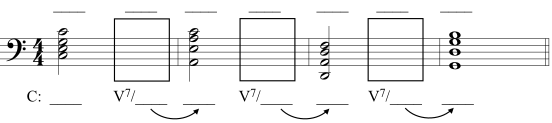
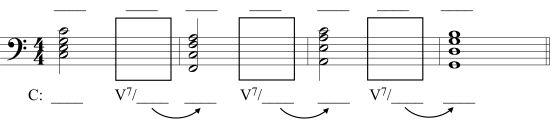
Answers — Part D
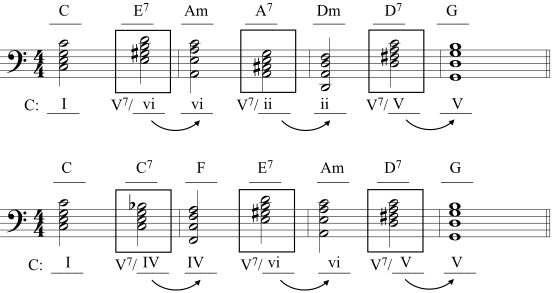
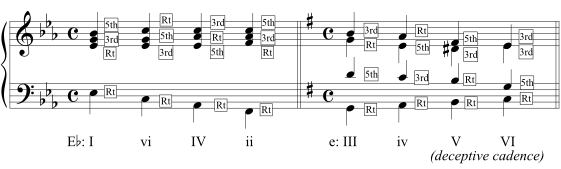
Part E: Voice Leading & Doubling (7 pts)
Keep track of doubling by specifying which voice has the root, third, or fifth for each chord.
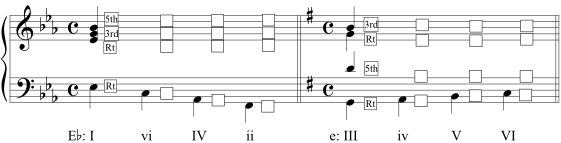
Answers — Part E
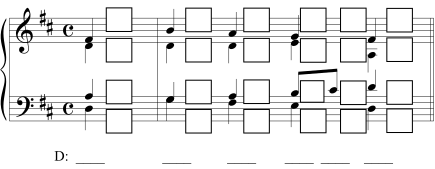
Part F: Voice Leading Analysis (20 pts)
Answers — Part F
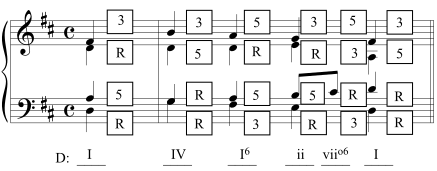
After checking your answer, practice naming the cadence type at the end of the excerpt and identifying one voice leading feature — label which voices are involved.
Section 2: Historical & Conceptual 30 min · 21 pts
EMC B1: Conducting Musical Research · EMC B2: Implications
For each question, the key terms and ideas you should use are listed. Connect them into a coherent argument — not just define them one by one.
Essay Rubric — Q15, Q16, Q17 (holistic per question)
| Band | Descriptor |
|---|---|
| Excellent (6–7) | Evaluates musical ideas from multiple perspectives; analyses connections to justify a reasoned conclusion; key terms used analytically with accurate terminology throughout. |
| Proficient (4–5) | Explains relationships between musical ideas; demonstrates understanding of context and conventions; mostly analytical with minor gaps; terminology generally accurate. |
| Adequate (3) | Describes relevant concepts correctly; identifies some connections; response is partly descriptive rather than fully analytical; terminology inconsistent. |
| Developing (1–2) | Lists or outlines facts in isolation; formulaic engagement; key terms missing, misused, or defined without connection to the question. |
| 0 | Does not address the question. |
Key distinction: analytical responses connect ideas and argue a position; descriptive responses only define terms one by one.
Q15 — Overtones, Diatonic Scales, and Turkish Makam (7 pts)
The overtone series naturally produces certain intervals. How might this have influenced the development of the diatonic scale in Western music? How does Turkish makam represent a different approach to organizing pitch? (5–6 sentences)
Key terms and ideas
- Overtone series / harmonic series — what it is, what intervals it produces
- Octave (2:1), perfect fifth (3:2), perfect fourth (4:3) — these appear earliest
- Diatonic scale — how stacking acoustically prominent intervals could lead to it
- Tetrachord / pentachord — the building blocks of makam
- Microtonal intervals — smaller than a semitone; central to makam, absent from equal temperament
- The contrast to make: Western music organized pitch around the most acoustically "natural" intervals → arrived at the diatonic scale. Turkish makam organized pitch around flexible smaller cells → produces modal variety and microtonality that goes beyond what the overtone series alone would suggest.
Q16 — Bach and the Well-Tempered Clavier (7 pts)
Why was composing in all 24 keys a statement about temperament, and not merely a technical exercise? What does this tell us about the relationship between tuning systems and musical possibility? (4–5 sentences)
Key terms and ideas
- Well-Tempered Clavier (1722) — what it is
- Temperament — the system for tuning a keyboard
- All 24 major and minor keys — what was unusual about this
- Equal (or well) temperament — why certain keys were previously problematic
- Pythagorean comma / wolf interval — what makes some keys unusable in older systems
- The argument to make: before equal temperament, some keys sounded noticeably worse than others on a fixed-tuning keyboard. Writing in all 24 keys was Bach demonstrating — with the music itself — that his tuning system made every key equally usable. The deeper point: tuning is not just a technical choice; it defines which musical ideas are even possible to express.
Q17 — Dissonance Rules and the Development of Polyphony (7 pts)
How did the avoidance of dissonance shape Western melody and harmony? How is the rule against parallel fifths part of the same tradition as musica ficta?
Key terms and ideas
- Consonance / dissonance — the distinction that drove all of these rules
- Polyphony — multiple independent voices moving simultaneously; what new problems this created
- Musica ficta — performers adding unwritten accidentals to avoid the tritone; practice before it became rule
- Tritone / diabolus in musica — the most aggressively avoided interval
- Parallel fifths / parallel octaves — why avoided: voices lose independence, texture collapses; same underlying logic as musica ficta
- Voice leading / counterpoint — the codification of these instincts into teachable rules
- The through-line to argue: musica ficta, the tritone rule, parallel 5ths — all the same instinct. Composers and performers were managing dissonance so voices stay clear and music feels controlled. These are not separate rules — they are one tradition, expressed at different moments.
Section 3: Performance Reflection 15 min · 10 pts
EMC C2: Understanding Performing Practices · EMC B2: Implications
Structure your paragraph to hit all three points:
- One specific musical decision — be concrete, not vague
- A voice leading principle — name it using the vocabulary we've studied
- Ensemble and personal constraints — how your players and your own abilities shaped the music
The goal is to connect your creative choices to musical understanding — not summarize the piece, but analyze one decision in depth.
Reflection Rubric — Q18 (holistic, 10 pts)
| Score | Descriptor |
|---|---|
| 9–10 | All three points addressed analytically; specific decision, named principle, and ensemble constraints integrated into one coherent argument. |
| 7–8 | All three points present; connection between decision and principle is clear; mostly analytical. |
| 5–6 | Three points present but treated separately; more descriptive than analytical; lacks a through-line. |
| 2–4 | One or two points missing or vague; response is mainly descriptive. |
| 0–1 | Does not meaningfully reflect on the musical work. |
Section 4: Glossary 15 min · 12 pts
EMC B1: Conducting Musical Research
For each term, your definition should address the questions listed.
| Term | What your definition needs to include |
|---|---|
| Chord tones | What they are; how to distinguish them from non-chord tones |
| Cadence | What it does harmonically; name at least one type |
| Equal temperament | What is "equal"; what it makes possible; what it sacrifices |
| Musica ficta | When performers used it; what interval problem it solved |
| Voice leading | What makes it "good"; at least one specific rule from this trimester |
| Contrary motion | Direction of each voice; why it is generally preferred |
Study Checklist
Grading Scale
| IB Band | Points / 101 | Ecuador Grade | Description |
|---|---|---|---|
| 7 | 85–101 | 9.00–10.00 | Excellent — thorough understanding, sophisticated analysis |
| 6 | 73–84 | 8.30–8.90 | Very Good — strong understanding, detailed work |
| 5 | 60–72 | 7.70–8.20 | Good — solid understanding, complete work |
| 4 | 46–59 | 7.00–7.60 | Satisfactory — adequate understanding, some gaps |
| 3 | 37–45 | 4.50–6.90 | Mediocre — partial understanding, significant gaps |
| 2 | 19–36 | 2.00–4.40 | Poor — limited understanding, major deficiencies |
| 1 | 4–18 | 1.00–1.90 | Very Poor — minimal/no understanding |
| — | 0–3 | 0.00–0.90 | Below IB minimum |
Grades within each band are interpolated linearly. Note IB Band 3 (37–45 pts) moves 0.30/pt while Band 4 (46–59 pts) moves only 0.046/pt — the conversion is not linear.
Sample conversion table — 30 representative scores
| Score | Ecuador | IB Band |
|---|---|---|
| 101 | 10.00 | 7 |
| 97 | 9.75 | 7 |
| 91 | 9.38 | 7 |
| 85 | 9.00 | 7 |
| 84 | 8.90 | 6 |
| 78 | 8.57 | 6 |
| 73 | 8.30 | 6 |
| 72 | 8.20 | 5 |
| 71 | 8.16 | 5 |
| 65 | 7.91 | 5 |
| 60 | 7.70 | 5 |
| 59 | 7.60 | 4 |
| 56 | 7.46 | 4 |
| 51 | 7.23 | 4 |
| 46 | 7.00 | 4 |
| 45 | 6.90 | 3 |
| 43 | 6.30 | 3 |
| 40 | 5.40 | 3 |
| 37 | 4.50 | 3 |
| 36 | 4.40 | 2 |
| 32 | 3.84 | 2 |
| 28 | 3.27 | 2 |
| 24 | 2.71 | 2 |
| 19 | 2.00 | 2 |
| 18 | 1.90 | 1 |
| 13 | 1.58 | 1 |
| 8 | 1.26 | 1 |
| 4 | 1.00 | 1 |
| 3 | 0.90 | — |
| 0 | 0.00 | — |
Orange dividers mark band transitions. The IB 3 band (37–45) climbs steeply — each point is worth ~0.30 Ecuador grade. IB 4–7 move much slower (~0.04–0.06/pt).